Mumbai suspect trial to proceed - BBC News Washington Post Mumbai suspect trial to proceedBBC NewsThe trial of the main suspect in the Mumbai (Bombay) attacks will continue despite his change of plea to guilty, the judge has ruled. Mohammad Ajmal Amir Qasab's confession will go on record but it does not address all 86 charges he [...]
Mumbai suspect trial to proceed - BBC News
 Washington Post | Mumbai suspect trial to proceed BBC News The trial of the main suspect in the Mumbai (Bombay) attacks will continue despite his change of plea to guilty, the judge has ruled. Mohammad Ajmal Amir Qasab's confession will go on record but it does not address all 86 charges he faces, … Judge accepts Mumbai gunman's confession Mumbai Gunman Says 'Hang Me' After Shock Confession Kasab's lawyer wants to quit; 26/11 trial will continue |
WASHINGTON, D.C.: Senate turns away gun measure - Chicago Tribune
 ABC News | WASHINGTON, D.C.: Senate turns away gun measure Chicago Tribune The Senate on Wednesday narrowly defeated an effort to allow gun-permit holders to carry concealed weapons across state lines. The 58-39 vote fell short of the 60 needed to overcome a filibuster. But the vote once again highlighted divisions within the … Senate kills concealed-weapons bill Senate rejects Feingold-supported concealed arms reciprocity Measure to ease carrying guns between states fails in Senate |
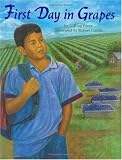
First Day in Grapes (Pura Belpre Honor Book. Illustrator (Awards))
All year long, Chico’s family moves up and down the state of California to pick fruits and vegetables. Every September, Chico starts at a new school. Often, the other kids pick on him — maybe because he’s always new, or maybe because he speaks Spanish sometimes. But third grade promises to be different. He likes his teacher, and she recognizes his excellent abilities in math — he may even get to go to the math fair! When some fourth-grade bullies tease him, he surprises them with strengths of his own.
Customer Review: Started many conversations
I borrowed this book from another teacher to read to the students in my resource room (grades 2 - 5.) Many of these students are of Mexican descent, though none of them are from migrant families. The book inspired much conversation, particularly on the topics of standing up to bullies and supporting students that are victimized by bullies. Discussions continued and passages were reread. The book moved from desk to desk and hand to hand. I realized I needed to keep this finger-smudged and cover-wrinkled edition and return a brand new copy to its wise owner. This is a book you will be happy to add to your classroom library.
Customer Review: I love this book and my kids do too
I received this book as a gift for my children who are in the primary grades. The story resonated with me because I remember tutoring little migrant boys like this when I was in high school, boys who are smart but have trouble in school because of constant moves. My children enjoy this story because they can empathize with his troubles and how he is ultimaately able to outsmart the bullies without using his fists. They enjoy seeing his victory at the end. I like the fact that it builds compassion in them for children who face adversity every day. I recommend it.
How to Grow Grapes for Excellent Wine
I think it quite safe to say that more has been written about the cultivation of grapes than has - or ever will be - written about any other fruit. This is not surpris?ing, considering that the grape is probably the oldest of known fruits. Surprisingly, grapes do not need loads of manures and fertilizers; [...]
I think it quite safe to say that more has been written about the cultivation of grapes than has - or ever will be - written about any other fruit. This is not surpris?ing, considering that the grape is probably the oldest of known fruits.
Surprisingly, grapes do not need loads of manures and fertilizers; they grow well on quite poor soils and need little after-attention. The roots will search out and find what they want; all we have to concern ourselves with is where to put the top-growth - the vine itself.
If one wall of your house faces south, south-west or even west, that problem is solved very easily. If you cannot plant the vine under that particular wall, plant it round the corner and train the vine round to the sunny side of the house. Grapes may be grown in the open garden in similar fashion to loganberries, or they may be trained over sheds, garages, out-houses and such-like.
Vines are not expensive, and if two are planted, the yield may be regarded as fantastic when considering the value of the wine that may be made for many years.
Planting is best carried out in autumn and in any case before Christmas. If planting against a wall, take out a hole about two feet each way and plant so that the stem of the vine is about fifteen inches away from the wall itself. Dig deeply and work in any compost that may be available and some builders’ rubble if you can get some. A dusting of lime forked in will be helpful. Spread out the roots well and plant as recommended for fruit trees.
Having planted the vine, spread a little manure above the roots: this will not be necessary in subsequent seasons, but the vine will benefit from a mulch each spring if you can give it one.
Vines must not be allowed to fruit the first season; therefore they must be cut back to about four buds.
Having planted the vine and cut it back, we must decide how to train it to cover the wall.
The best plan is to use special wall nails, run wires to and from these and train the vine to the wires.
The four long growths that come from the four buds you left when cutting back are stopped at the bud nearest the growing point. These four leaders are the basis from which the vine will be built up to cover the wall. If flower buds form during the first season, they should be nipped off so that the vine uses its energy producing wood for subsequent fruiting. First-season fruiting often permanently weakens a vine.
When pruning, remem?ber that next year’s fruit will be borne on the wood made this year. But we do not want masses of long, straggling growths hanging about all over the place, so during the summer it is best to cut some of them out. Those left to bear next year’s fruit should be cut back to five or six buds in autumn or early winter. Only new growth should be cut during the summer; never cut old wood during summer - indeed old wood must never be cut after Christmas, as this can cause profuse bleeding which may be quite impossible to stop. By all means cut away some of the old growth to make way for new wood, but if this has not been done before Christmas leave it until the next winter.
Many varieties ripen in September - or earlier if the summer has been good. This is especially advantageous because the weather is still warm enough for a satisfactory fer?ment when you come to make the wine. This is not so important to those who carry out their fermentation in the house, but where it has to be carried on in a shed or outhouse the warm weather is a great help.
-
 The Grapes of Wrath (New Longman Literature: Steinbeck)
The New Italian Wine Guide
Special Feature, How to have an Italian Wine Tasting

No comments:
Post a Comment