Between rebels on the rampage and army on the run - Guardian UnlimitedVillagers from across eastern Congo head for Goma ahead of an advance by Tutsi rebel commander Laurent Nkunda. The UN has warned of a looming catastrophe in the region. Photograph: Walter Astrada/AFP/Getty Images Ban Ki-moon, the UN secretary general, has warned of a [...]
Between rebels on the rampage and army on the run - Guardian Unlimited
Villagers from across eastern Congo head for Goma ahead of an advance by Tutsi rebel commander Laurent Nkunda. The UN has warned of a looming catastrophe in the region. Photograph: Walter Astrada/AFP/Getty Images Ban Ki-moon, the UN secretary general, has warned of a crisis of “catastrophic
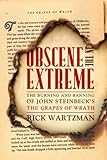
Obscene in the Extreme: The Burning and Banning of John Steinbeck’s the Grapes of Wrath
When W. B. “Bill” Camp, a giant cotton and potato grower, presided over its burning in downtown Bakersfield, he declared: “We are angry, not because we were attacked but because we were attacked by a book obscene in the extreme sense of the word.” But Gretchen Knief, the Kern County librarian, bravely fought back. “If that book is banned today, what book will be banned tomorrow?”
Obscene in the Extreme serves as a window into an extraordinary time of upheaval in America—a time when, as Steinbeck put it, there seemed to be “a revolution . . . going on.”
Customer Review: Great, but I wish it were longer
Obscene in the Extreme was a natural for me. Steinbeck is my very favorite writer. I remember being shocked the first time I saw that image of farmers burning a copy of The Grapes of Wrath.
Obscene in the Extreme details Kern County’s ban on The Grapes of Wrath. A book that was a lightning rod on its’ publication. Praised as a masterpiece and banned in some rural locations for the coarse language it contained. Kern County used this same reasoning when banning the book, though it was obvious to all that it was the politics of the book that were the real problem.
The problem I had with the book is that it is either too short or casts too wide a net. Rick Wartzman uses the banning of The Grapes of Wrath to examine state and national politics of the time and it was a valid approach but too many names were thrown at me too quickly in the 280 or so pages the book ran.
The book is worth reading and there is a lot of fascinating details in it. But if you don’t already know a bit about the political scene of the late thirties/early forties you may find yourself flailing a bit.
Customer Review: Likely to Become the Defining Work on the History of Labor and Farming in the Valley in the 1930s
Was the “Grapes of Wrath” a nonfiction work disguised as a novel? Apparently, the County Board of Supervisors in Kern County California thought just that. The book, and Steinbeck, irritated them to the point that they decided to ban the work and prohibit its sale from bookstores (not that there were many in Bakersfield then) and distribution of the work from the library system.
Why, however, did the book cause such irritation amongst the county supervisors and why were they in such an immense hurry to get it away from the public? The answers to those questions are the backbone of this wonderful work on a shameful chapter in American history.
The author examines, in totality, the world of the San Joaquin Valley in the late 1930s and how a single novel could turn much of the State of California into a battleground for workers and farmers alike. From the Okies pouring into the Valley by the car load and trying to survive by any means possible to the farmers fighting to keep prices high and labor costs low, the complex story of this war in the Valley is told in a wonderful manner that makes the book extremely readable while documenting history in detail.
I could write about the debates that raged in the Valley (and the state) about communism, socialism, fascism and other “isms”, but that would be a spoiler to this wonderful book. In many ways the message in this work of history is as applicable today as it was 80 years ago.
I cannot recommend this book highly enough and think it may be one of the best non fiction works published in 2008. Buy it, explore it and enjoy it. I know the teachers at my local high school are already in a frenzy to read this and they won’t be disappointed.

No comments:
Post a Comment